
Hello & happy holidays all! I’m back (finally) to share my top reads of this past year. I didn’t read as much as I had hoped this year, but I deeply enjoyed the books I did get to. I have seven stand outs from the thirty-or-so I read: three releases from this year, one poetry collection, one memoir, one Morrison short story, all seven by women.
Within this list, presented in no particular order, I think there is a selection for everyone. I hope you find something to enjoy, and I would love to hear about your recommendations from this year as well!
No One is Talking About This by Patricia Lockwood
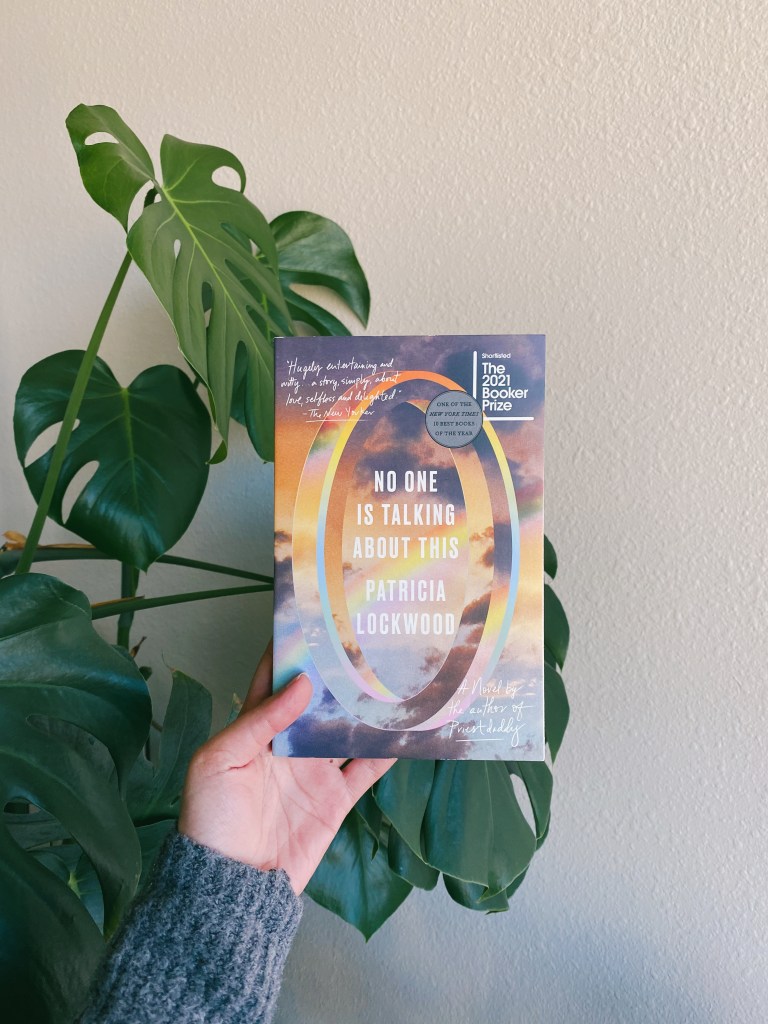
A theme I have been drawn to this year, in fiction and media broadly, is critique of Internet culture. We live in a uniquely stimulating time, with the opinions, photos, and stories of millions of people accessible so easily via social media. While a lot of writing can fall into cliche tropes about social media culture, Lockwood’s Booker prize and Women’s prize nominated novel marvelously captures the sublime reality of the internet today, clearly written by someone well versed in social media herself.
No One is Talking About This has been a go to recommendation for friends of mine struggling with questions of how we connect with others, and the boundaries between personal and public experience. Told in two parts, split by a defining plot point, this novel tells the story of an influencer on the “Portal.” Through her reflections, and processing of personal griefs, Lockwood reflects on how social media distorts how we connect to each other, process information, and the very language we use.
Recitatif by Toni Morrison with introduction by Zadie Smith
This year, Toni Morrison’s only short story, Recitatif, was rereleased with an introduction by the incredible Zadie Smith. I had never read this short story before, and was graciously allowed access to the audiobook by Libro.fm and Penguin Random House Audio. The short story follows two young girls who meet in an orphanage, Twyla and Roberta. As they grow up, their lives converge and diverge. One woman is Black and the other is white, though Morrison intentionally does not reveal which is which. This leads the reader to challenge our own assumptions about the characters, as well as the defining moments within the story. It is a reflection on memory, how lived experiences can be encountered in completely differing ways. The analysis by Zadie Smith offers helpful context and analysis, though I would recommend reading it after the short story rather than before (as it is presented in the release edition).
The Book of Form and Emptiness by Ruth Ozeki
In my very first post on my bookstagram account, I cited A Tale for a Time Being as one of my favorite books ever. That has remained true, so it’s a wonder that it took me so long to pick up Ozeki’s newest book, The Book of Form and Emptiness. Yet, this book found me at the perfect time— I was on my month long psychiatry rotation this past summer and found myself a copy, unaware that part of the book takes place in an inpatient psychiatric facility.
The Book of Form and Emptiness is about how grief reshapes families, and about how grief can alter our perception of the world. Benny, a teenage boy, loses his father, and consequently begins to hear objects speaking to him. The novel, primarily narrated by the book itself, follows Benny’s attempts to mask his new perceptions, his deteriorating relationship with his mother, and his budding friendships with a band of misfits at the public library. Eccentric, touching, and spiritual, Ozeki’s most recent work did not disappoint, and has left me desperate for more of her writing.
Customs by Solmaz Sharif is the only book I bought on its release day this year. Since reading her incredible first collection Look (a finalist for the National Book Award in poetry), I have been eagerly following Sharif’s work— watching her speak on YouTube, reading her pieces across publications. Customs, a collection about the existence, expectations, and enforcement of the culture, is an incredible work that I have read and reread throughout the year. The language is transformational, the work is staggering. Sharif has solidified herself as one of the most insightful, unflinching poets of our time.
The Candy House by Jennifer Egan
I read Egan’s famous, form-bending A Visit From the Goon Squad a few years ago in a contemporary novel course in college. While I appreciated Goon Squad for its wide, interlocking of web of characters, I had found that the final chapter had left much to be desired and offered only a shallow conversation about technology. Years later, Egan’s sequel, The Candy House exceeded all my expectations.
Building off of the web of characters from the first book, (though this book could be read without reading the first one, the experience will be enhanced if you have read Goon Squad), The Candy House explores the boundaries of personhood and what happens when the self becomes a public entity. It is told in self contained chapters, all connected but following a specific timeline or plot line together. We are introduced to a service where people can collectively upload their memories, and the chapters explore how this disrupts the fabric of interpersonal interaction. This novel offers so many approaches to how we use social media, how we surveil each other, and how memory forms who we are.
Like Ozeki above, I’ve been talking about Yoshimoto’s work since I started my blog. Kitchen is one of my favorite novellas and her short story collection Lizard was on my top list of reads last year. I found Amrita, Yoshimoto’s longest and most complex work, at the discount table in a bookstore in Austin, Texas, when I was visiting my best friend. A few months passed between buying and starting the book, but once I got into it, I was entranced.

Amrita is a story about family, ghosts, and memory following a young woman named Sakumi. Sakumi’s younger sister, a celebrated actress, takes her life at the beginning of the book, and a head injury causes Sakumi to lose a significant piece of her memory and personality. She seeks to rebuild her life, connect to her young brother who is undergoing a mystifying transformation, and understand who she is. Filled with whimsy and spirit, this story flickers between realities and lands in the in-between of grief.

This past year, I found myself reaching for the memoirs and reflections on craft by artists and writers I admire. Patti Smith, “the punk poet laureate,” shares her intimate relationship with friend, lover, and creative partner Robert Mapplethorpe in her memoir Just Kids. Written on a death-bed promise, Just Kids describes how Smith moved to New York City at a young age, committed to becoming an artist alongside Mapplethorpe, and built a life for herself among legendary artists of the 1970s.
I recommend this book for anyone creative, but especially poets. It is an inspiring read and a fascinating insight into the literary scene of New York a few decades prior. It is also an incredible story of connection and care, of all the different ways love can look.
Note: links to each book are affiliate links through my Bookshop.org store front.
 zoreads