
2020 is finally coming to a close. But, more than ever, the new year doesn’t feel like a beginning or an ending. The pandemic is ongoing and severe, the inauguration isn’t until mid January. It’s hard to reflect on goals or create new ones; we’ve seen how unpredictable the world can be. Still, one of my favorite parts of the New Years celebration persists— the “best of 2020” lists. I love reading rankings of the best music, films, or books of the year, and am always excited to create my own.
This year, my reading was all over the place. Sometimes I just wanted a lighthearted read to forget about the pandemic, other times I wanted to relish in the heavy and emotional. Some months I read eight or nine books, other months I read none. Overall, I read 45 books, most of which were literary fiction and poetry. Of those 45, only a few were 2020 releases, so most of the titles on the list below will be backlist titles.
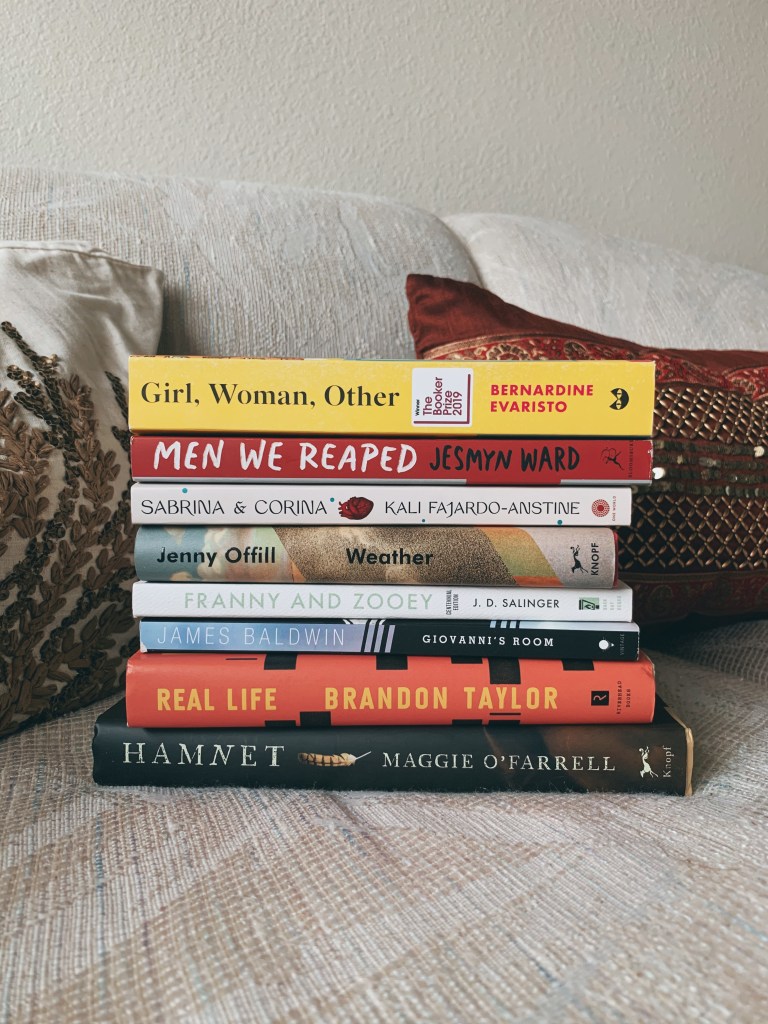
Here are my top 8 reads of 2020:
8. Weather by Jenny Offill
Weather was one of the first books I read and ordered in pandemic time, and it was quite fitting. This short, fragmented novel is a beautiful testament to modern American life. We follow a librarian as she takes care of her brother who is recovering from addiction, copes with the fallout of the 2016 election, and answers emails written by conspiracy theorists for work. Ultimately, Weather is a collage of moments and poignant writing about finding optimism and coping with the strangest, most difficult times.
Offill captures the overwhelm of living in our society today, with the pressures of the personal and political, without attempting to “solve” it. This is why I find this novel so moving for the pandemic time; we are surrounded by unsolvable questions, which have created beautiful or painful moments, but as much as we try there are no easy answers. Moving in form and prose, Offill’s novel is one of the most apt and reflective works I’ve read from quarantine.
7. Franny and Zooey by J. D. Salinger
“At least I’m still in love with Yorick’s skull. At least I always have time enough to stay in love with Yorick’s skull.”
This is a classic title I’ve been meaning to read for years— a novel that comes up at dinner parties and in used book stores. I somehow graduated with an English literature degree without ever encountering Salinger’s work, so a few days after graduation last spring, I picked up Franny and Zooey.
This book is composed of two connected novellas, the first of which featuring Franny Glass and the second centering her brother Zooey Glass. In the first, Franny has a nervous, moral breakdown upon visiting her boyfriend for the weekend. The reunion between the two college students takes place primarily at a restaurant in a prolonged, intense scene. As Franny critiques elitism in higher education, masculinity, and the treatment of women in academia, we both empathize with her and are put on edge.

The second novella takes place months later and we begin to understand the Glass family. We see Zooey interact with his mother, brothers, and Franny as the family copes with Franny’s recent “odd behavior.” This novella is smart and flamboyant and highly quotable; it describes family dynamics, coming of age, and how we develop a system of morals.
Together, these two novellas were a strong introduction to Salinger’s work and truly enjoyable, punchy read.
6. Real Life by Brandon Taylor
Real Life is one of the first books I read after starting medical school this fall. I’d been meaning to pick it up all year, mostly due to its cover, critical acclaim, and raving reviews. But it wasn’t until I finally read the full synopsis that I finally ordered my copy— a novel about a doctoral student facing challenges of being a minority in science academia, about loneliness and feeling disconnected from meticulous research work, immediately felt like a must-read.
This novel is truly moving. It is written in such beautiful prose as it explores grief, intimacy, and pain. It follows Wallace, a gay, Black PhD candidate in biochemistry at a midwestern university over the course of a few days. He attempts to find meaning in his biochemistry experiments, connection in a system that enables racism and discrimination, and understanding of his own experience. Taylor presents a full cast of real and fleshed-out characters, each with their own tensions and motivations. The events that unfold between all the characters feel so true and honest; Real Life is an unflinching and at times uncomfortable read.
5. Sabrina & Corina by Kali Fajardo-Anstine
This year, I’ve picked up a few short story collections, among which Sabrina & Corina was my favorite. This short story collection has a strong sense of location and community; each story follows Indigenous Latina women in Denver, Colorado. The stories are immensely readable and intimate, dealing with themes of family, tradition, and isolation. Within these similar themes however, the stories cover a wide range of topics and personalities, each enriching in a unique way.
It’s hard for me to recommend individual stories in this collection because I truly enjoyed every single one— from the complicated familial relationships and traditions in the story Sabrina & Corina, the story Remedies about a family struggling to deal with a lice outbreak, to the haunting final story, Ghost Sickness.
This collection is a standout as a reader and a lesson as a writer; there is so much to learn from Fajardo-Anstine’s stories and craft, and I look forward to reading more of her work in the future.
4. The Men We Reaped by Jesmyn Ward
I’ve been making my way through Jesmyn Ward’s body of work the past few years. Her work is well crafted, engrossing, and speaks to important and often overlooked experiences. Though I’ve enjoyed all her novels, her memoir The Men We Reaped has been a stand out.

This memoir tells the story of five young Black men in Jesmyn Ward’s life who passed away over a period of five years. As Ward describes her relationships with these five men— from her friends to her own brother— and their tragic, premature deaths, she also describes her own family history and personal grief. As she tries to make sense of the grief, she describes structural and institutional racism, violence, and murder against Black men.
Ward is an incredible storyteller; this book was hard to put down, even when it was so full of pain and hurt. I highly recommend this book to anyone, including those who don’t often pick up memoirs, because it is just so moving.
3. Hamnet by Maggie O’Farrell
Hamnet is a novel I saw on bookstagram all year— again and again, people called it favorite of the year and a favorite of all time. When I had time off for the holidays, this was the first book I picked up. It is about the death of Shakespeare’s son Hamnet, the namesake of the classic play Hamlet. But the novel isn’t really about Shakespeare— in fact, his name isn’t mentioned by a single time. It’s a fictionalized account of Shakespeare’s wife, of his family, and of their country life as he is off writing plays in London. It is about the son Hamnet as he grows up, passes away, and is grieved.

Hamnet a magical and devastating read about the plague, motherhood, and tense family situations. The writing is rich and full of the natural world. This novel is both literary and readable, character based and plot driven, historical and fantastical. This is a book that truly lived up to its hype, and one that I think many people will enjoy.
(side note: through Hamnet and Saunders’s Lincoln in the Bardo I think I have unearthed a new favorite niche genre: books about the death of famous historical figures’ 11 year old sons)
2. Giovanni’s Room by James Baldwin
Earlier this year, I studied the work of James Baldwin in school and on my own. I read nearly his entire body of work, and found each novel, essay, and play full of insight, sharp writing, and emotional intimacy. While I was tempted to put multiple Baldwin works on this list— from his semi-autobiographical debut novel Go Tell It On the Mountain to his resounding The Fire Next Time— but I ultimately decided on including just this one work, Giovanni’s Room.

Giovanni’s Room follows the love story of David, an American in Paris whose girlfriend is in Spain contemplating their engagement, and Giovanni, a bartender that, as we know at the start of the book, is fated for execution. In a slim novel, Baldwin tackles the confines of masculinity, the internal and external pressures placed on queer men, and how poverty enables cyclical violence, often through the judicial system.
Baldwin’s writing will always be some of my favorite; I have kept so many notes of quotes and pages from this novel, but one that summates this novel is: “I dropped my brick and went to him. In a moment, I heard his fall, and at moments like this I felt that were merely enduring and committing the longer and lesser and more perpetual murder.”
1. Girl, Woman, Other by Bernardine Evaristo
And finally, Girl, Woman, Other. This book! I can’t remember the last time I’ve read a recently published novel that I’ve felt as passionately about as this one. One of two 2019 Booker prize winners, this portrait of contemporary society is unique in form, scope, and spirit.
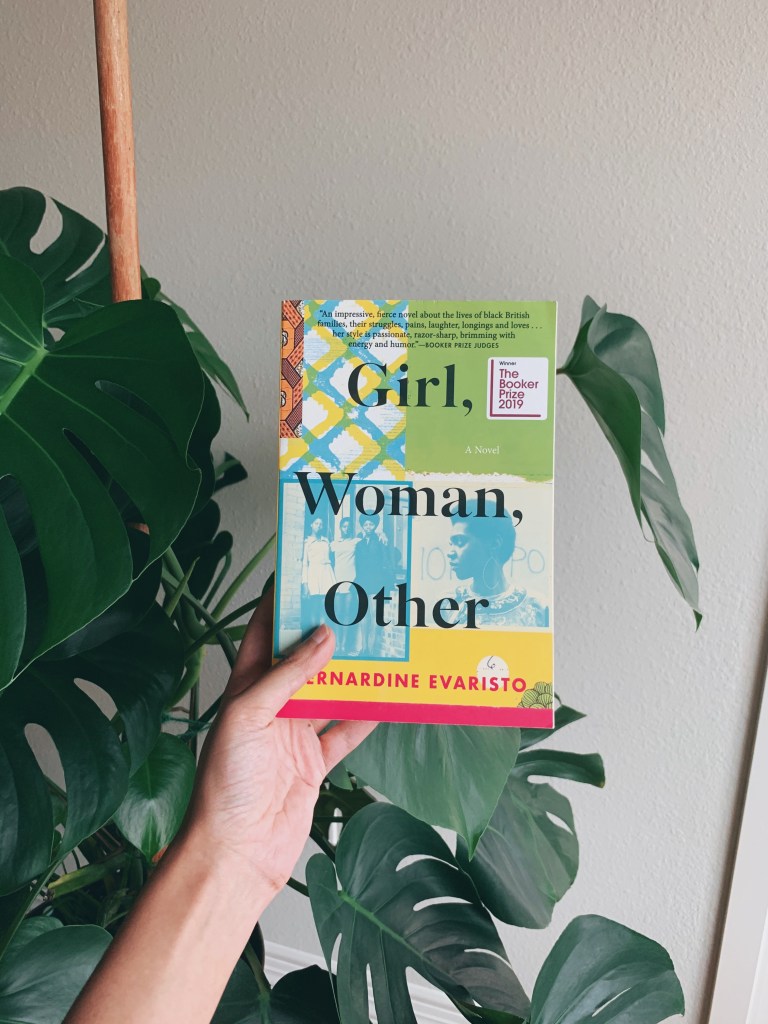
Through a series of character portraits, we travel across the UK and the world. The characters are primarily Black and primarily women (though there are nonbinary and male perspectives too!) and cover a large range of ages, socioeconomic classes, traditional backgrounds, and lived experiences. We start with the story of a playwright and then hear from her daughter, a nonbinary social media influencer that inspires that daughter, the playwright’s good friends, friends of those friends, etc. As all these portraits and characters are intertwined with one another, we are provided a diverse portrait of race and gender, radical feminism and parenthood, trauma and survival.
Additionally, this novel uses deconstructed sentences that flow like poetry but remain immensely readable. It is an incredible example of how form can supplement a novel’s content; how a form can be experimental and literary yet still immensely readable and engrossing. Ultimately, Girl, Woman, Other was the novel that awoke me from my early quarantine reading slump, that inspired me to write and read more broadly, and that I recommend most often to friends and family.
 zoreads