
Over the past few years, I’ve grown as an increasingly critical reader. Critical reading means a lot of things–– engaging more actively with the text, looking beyond surface-level readings, and questioning the work with a more critical lens, among them. My literature courses in college have helped me gain these skills and completely changed how I read and interact with novels.
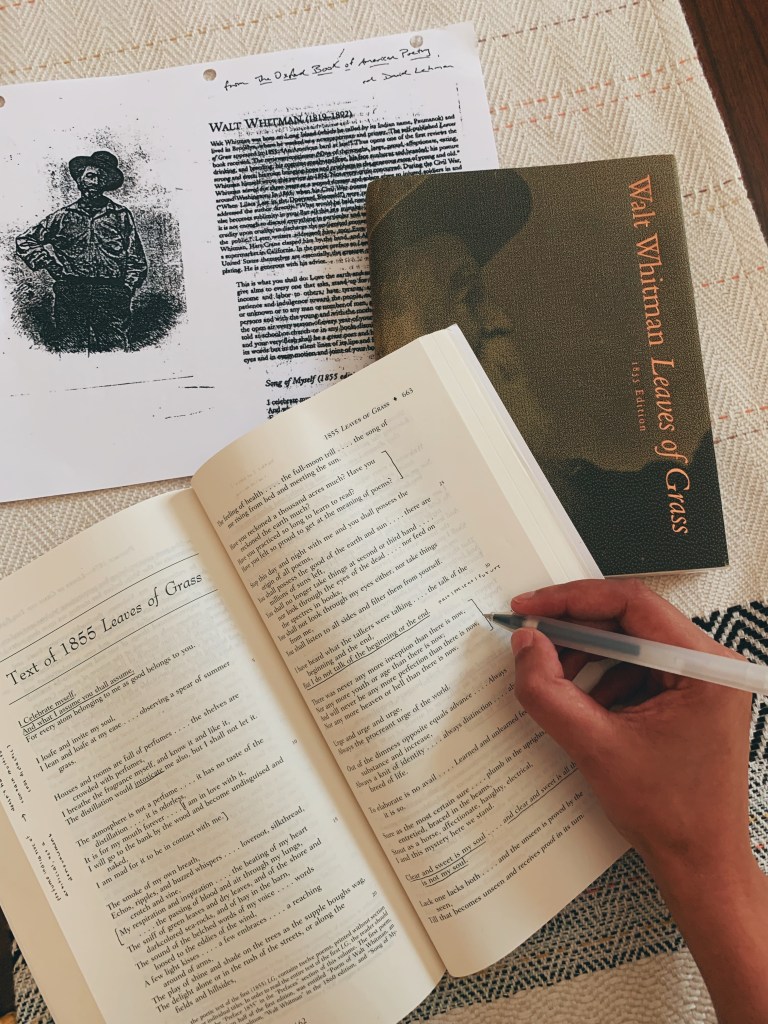
While critical reading has refined my tastes and deepened my reading experience, it certainly isn’t for everyone. Some “downsides” can be that it can take longer to get through books, it can be harder to find books enjoyable on a pure entertainment level, or that too much active engagement makes reading feel like a chore. These downsides aren’t ubiquitously felt–– I’ve found that I find books more entertaining when I can reflect on them critically and feel “rewarded” for doing so, for example. (By “rewarded” I mean gaining additional insight or filling in what seems to be another piece in the puzzle).
If you are interested in increasing your engagement with the books you read, you can try annotating them. Annotating texts is like having a conversation with them while you read; it builds reflection and absorption into your reading. I originally started annotating my books for class, but now I tend to annotate almost all the books I read to some degree.
There is no right way to annotate. You can annotate however you choose, whether that be writing notes in the margin of every paragraph or not annotating at all. I suggest trying out different annotation styles to see what works for you.
I have seen other English majors annotate using multiple color pens or other very developed systems, which you should look into if you’re interested in more involved styles. I prefer quicker and less involved annotation processes so that I can read critically but still keep a fair pace.
Below are some of my annotation styles and why I use them, as well as other tips I have on the practice.
What do my annotations consist of?
What I annotate shifts from text to text. If I’m reading a book for class, my annotations will be more focused on formal elements, themes, and questions, while if I’m reading for pleasure I will focus on beautiful passages or my reactions to the text. Here is a broad list of various features I take note of or draw attention to with my annotations:
1. Beautiful or compelling passages: If there is a passage with beautiful language, an interesting idea, or just remarkable writing, I highlight or underline it to revisit later. As a writer myself, I frequently revisit passages of strong writing to see what I can learn from them. After I finish a book, I usually copy these noted passages down in a notebook or on my phone as well, so I can carry quotes I love with me.
Example, from Tom Stoppard’s Rosencrantz and Guildenstern are Dead:
“We cross our bridges when we come to them and burn them behind us, with nothing to show for our progress except a memory of the smell of smoke, and a presumption that once our eyes watered.”
2. Passages related to a theme that interests me: When I have to write a literary analysis on a novel, which I do frequently for class, I typically develop an idea by tracking a few themes that interest me throughout the novel then studying passages related to that theme. I enjoy this process, so I generally look for and track themes in any novel I read. Some themes of frequent interest to me are maternity, migration, diaspora, science and medicine, healing, storytelling, and grief.
Example: passages in Frankenstein that explicitly mention science or medical advances, passages in Pachinko about motherhood and maternity
3. Repetition of images, phrases, or words: If I notice that certain words, images, or specific phrases are repeated, I’ll start taking note of them and the contexts in which they are used. I will sometimes keep a running list of page numbers of all the instances of repetition.
Example: the repeated image of blood in Gabriel García Marquez’s novella Chronicle of a Death Foretold
4. Literary devices: Formally, I take note of any literary devices used and passages are particularly strong in mood, tone, or voice. Here is an informative website about various literary devices if you’re interested in learning more about them. My favorite literary devices (ones I am especially excited to see done well) are character foils, extended metaphors, and faulty parallelism.
5. References or definitions: I make sure to look up any unknown definitions or references I don’t understand– essentially providing footnotes for myself. If I have a cell phone handy, I’ll quickly search it up while I’m reading, but if not I mark the passage and return to it to complete the annotation later.
6. My reactions to moments in the text: This one is pretty self-explanatory– if I’m confused, I’ll write questions; if I’m shocked, I’ll include exclamation points; if I disagree or agree with a statement, I’ll take note. This is a way for me to interact more with the text, and understand how it evokes certain reactions when I look at the notes in retrospect.
Methods for Annotation
1. Writing in the text
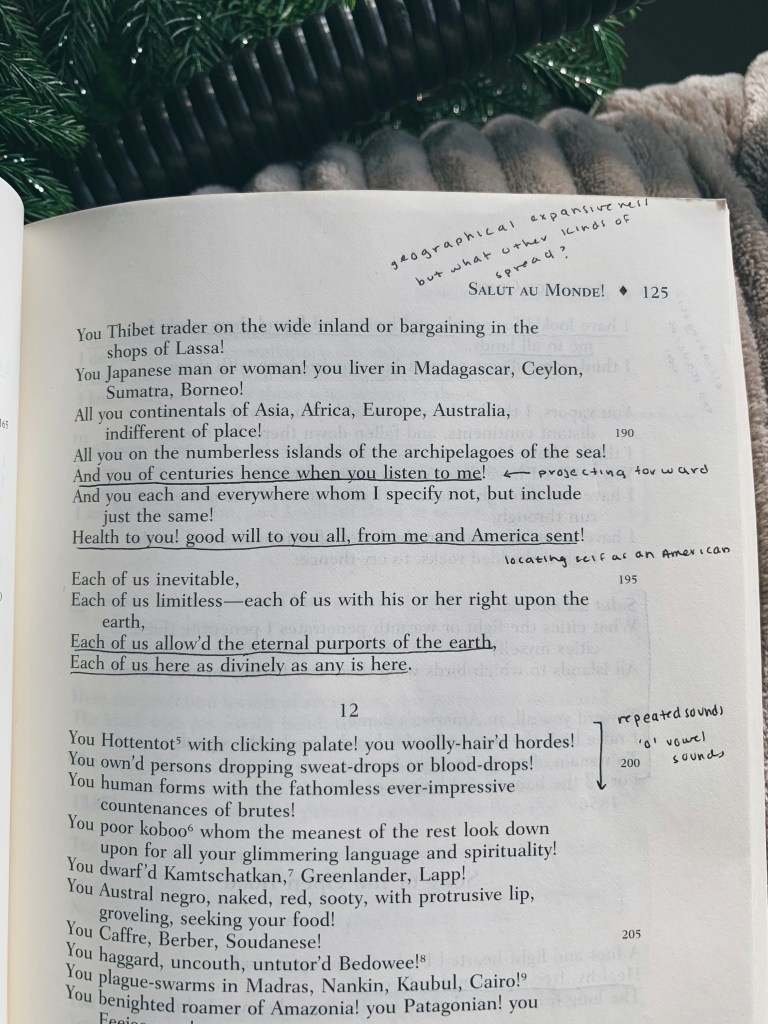
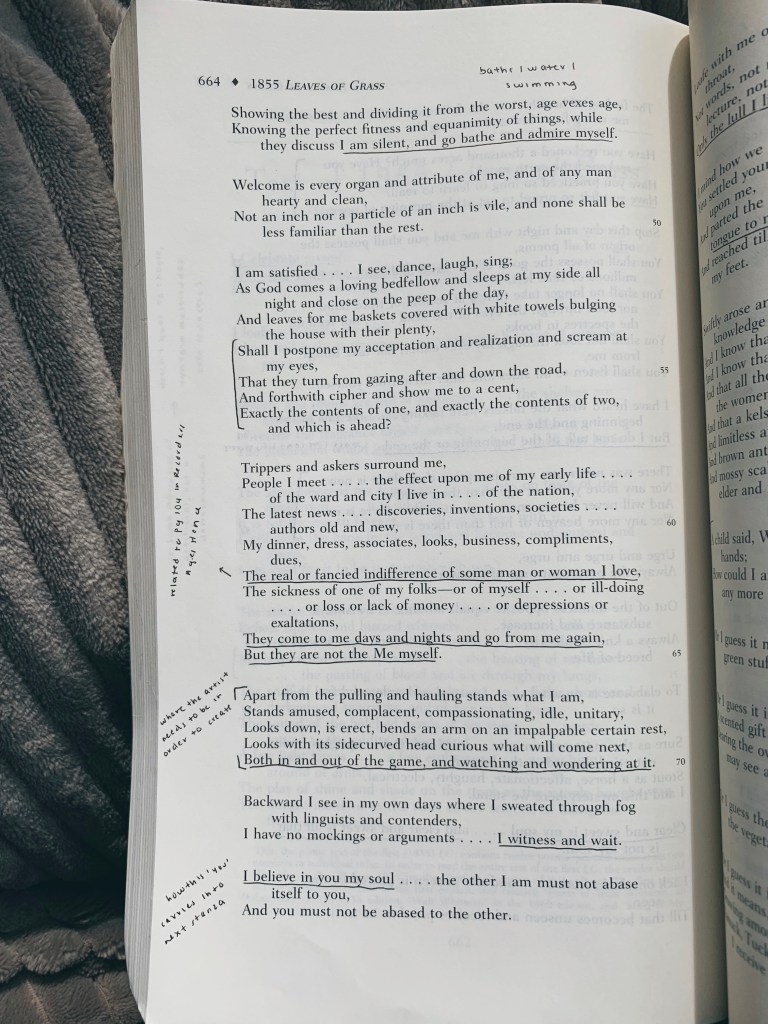
The easiest method for annotation is writing on the text itself. I personally love the look of books littered with notes in the margins. However, I’m frequently hesitant to write in novels I own because I dislike re-reading books with my annotations in them, because I feel constrained to the same reading experience I had the first time. I most frequently annotate poetry in the text, because annotations typically enhance my reading experience for poems even upon re-reading.
Here is an example of what these annotations might look like:
2. Using sticky notes and a notes document

If I don’t want to write directly in my novel, I use sticky notes to mark passages that are interesting to me. Adding a sticky note doesn’t require me to disrupt my reading experience as much as writing full notes in the margins, but does let me revisit passages of interest easily.
This is especially of use when I am writing an essay on a novel, because I can read the novel fairly quickly for class, tracking themes or compelling passages with various colored sticky notes, then revisit those notes for deeper reading when I write a literary analysis. Often, when I use sticky notes in a book for class, upon finishing the novel, I type up a document of notes for the passages I had marked with the stickies. I’ve included an example of what that looks like below:
3. Using a journal
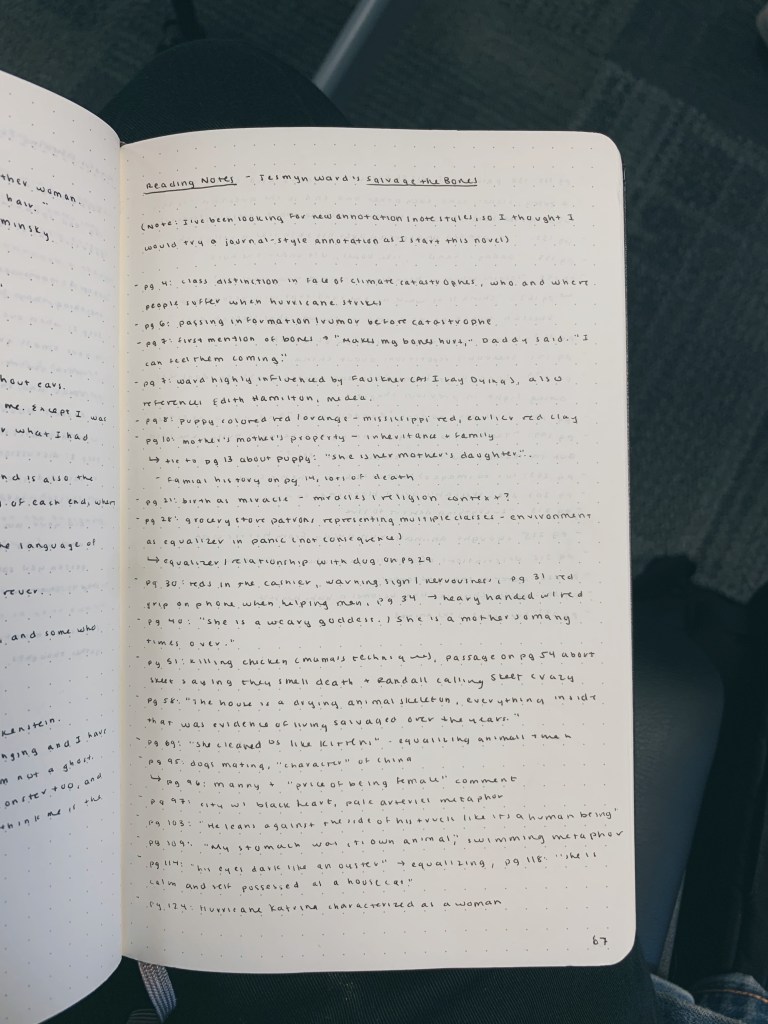
If I want an experience similar to writing on the text but I can’t write in the book (i.e. if I have a library book, or want to annotate a novel without writing on the text), I use a notebook for annotations. When I read, I keep my notebook open next to me, and while I’m reading, I write notes in the notebook, including the page number and paragraph or sentence I’m referring to. Here is what these notes look like:

4. Thematic summaries at the end of chapters
One way to annotate novels for themes, images, and literary devices without taking notes and pausing constantly through the reading experience is to do summaries at the end of chapters instead. This allows you to pause and reflect at a set interval– each chapter– but still stay engaged with themes and literary devices through your reading experience.
5. Notes on my phone with quotes, themes, and page numbers
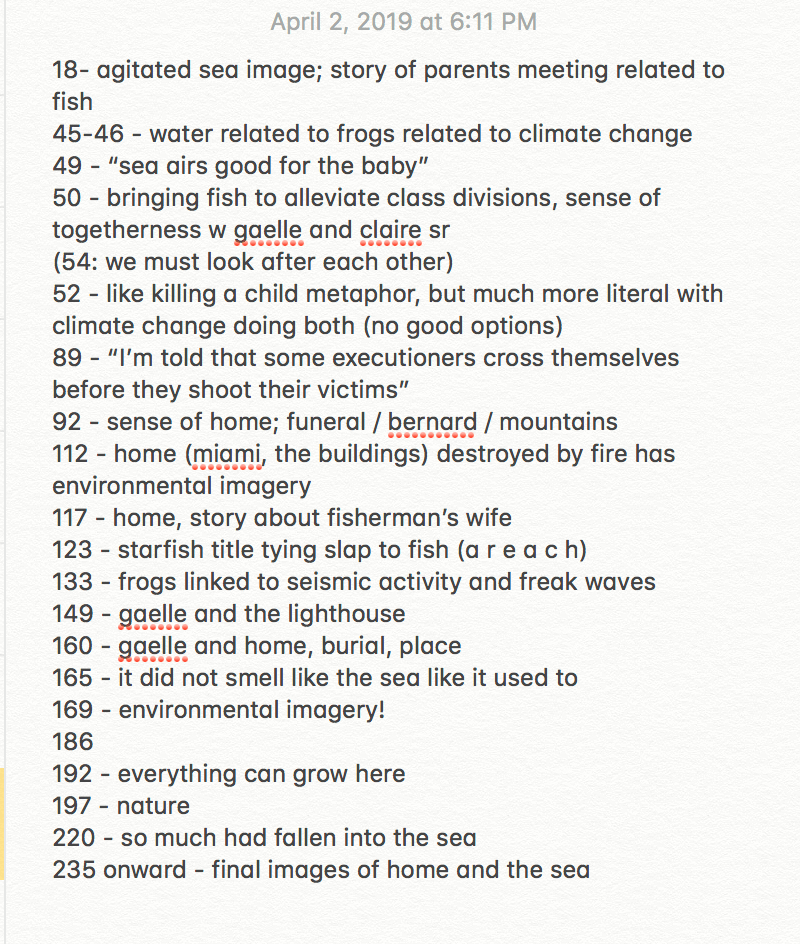
Similar to using physical notes, I sometimes take notes on my phone on the books I read. If I don’t have my notebook on me, or am having a more casual reading experience, I use my phone for these notes. I just include short quotes, page numbers, or themes with corresponding page numbers.
Here is an example of what my digital phones look like for Edwidge Danticat’s Claire of the Sealight (note: for this example, I was writing an essay about the role of the sea in the novel, and was quickly re-reading the novel and noting down passages I might want to use):

I hope this post has been a helpful guide and provided ideas to help with annotation if this is something that interests you! If you’re interested in studying literature in an academic setting, annotation is a critical piece of the reading experience. With time, I’m sure you will develop your own annotation styles, and you shouldn’t feel the need to always cohere to the same one. Annotation is just one practice to help become a critical reader, but there are many other ways to engage meaningfully with text.
Thanks for reading! 🙂
 zoreads